


By P. Gunasegaram
 Tiger is puzzled. Is the economy overheating? Has the US raised interest rates? Or is it tapering its quantitative easing even faster than expected? Is there a crisis of confidence in Malaysia? As the answer to each of the questions is no, why should Bank Negara raise interest rates now?
Well, it seems the majority of economists have decided that Bank Negara Malaysia should raise the overnight policy rate or OPR by 0.25 percentage points to 3.25% a year from the current 3.0%.
But if the central bank sets monetary policy according to majority opinion, it will be a major mistake. No matter what most economists say, Bank Negara must set the benchmark interest rate according to what the evidence is.
Tiger would like to humbly state its own opinion and would courageously like to proclaim that now is NOT the right time to raise interest rates. Oh sure, the market will be disappointed if Bank Negara did not raise the OPR, and yes the ringgit may come down a bit but really that’s not the criteria at all.
When most of the world has kept interest rates unchanged, and some of them at very, no change that to extremely low, levels there must be good reason for Bank Negara to raise interest rates. If there is none, don’t – at least not on Thursday when the decision is to be made.
The countries that have higher interest rates have certain peculiar problems which are not present in Malaysia yet and therefore should not be part of the comparison that we make.
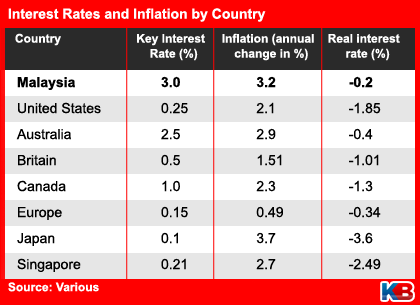 Take a look at the table of interest rates and inflation for the different countries and regions for some illuminating information
Which country among those listed has the highest interest rate? Yes, Malaysia. Which has the highest real interest rate, that is after taking into account inflation. Again Malaysia. When neither the US nor any of the developed nations are cutting interest rates, there is no reason why Malaysia should when its interest rates are already very high on a comparative basis.
Yes, Malaysia’s real interest rate is negative but that is so for most countries in the world – it is a reflection of the world’s economy which remains in the doldrums and which needs low interest rates to recover. Even Singapore has a negative real interest rate of nearly 2.5% against Malaysia’s just 0.2%. In the US, there is a negative real rate of return of 1.85% (A negative real interest rate simply means that the inflation rate is higher than the interest rate – the return on money is less than inflation. The more negative it is, the worse it is for the saver – and right now the economy does not want savers.)
This negates one of the reasons advanced for increasing interest rates which is to improve the real rate of return on interest rates in the face of rising inflation. The fact is among the countries compared, Malaysia’s real return on money, bad as it is, is the best!
 Some erudite economists say that one of the reasons that Bank Negara should raise the benchmark interest rate is the rising inflation. But much of this is due to one-off effects such as removal of subsidies. One should not be changing the course of monetary policy to adjust for these.
If inflation is a result of an unsustainable rise in demand caused by using credit to fuel an increase in appetite for goods and services, then an interest rate increase is justified. But that’s not the situation now. Prudential measures taken earlier to rein in property spending and purchase of cars are already beginning to bite and there is no reason to bring in the heavy artillery.
True, domestic demand is one of the engines of growth but curtailing this at a time when economic growth is still anaemic internationally is the wrong thing to do and will be akin to killing the golden goose which has helped the Malaysian economy weather international uncertainty.
While the domestic economy expanded a good 6.2% in the first quarter of this year, the same economists who expect an increase in OPR expect growth in the second quarter to slow. It is not as if 6.2% is a very high growth rate and if it is already slowing why exacerbate the situation by raising interest rates.
 In a situation where the general public is already primed for hardship through removal of subsidies and the imposition of the goods and services tax (GST), an increase in interest rate is the last thing that the consumer wants – even if it is small, it still increases his costs. And maintaining confidence among Malaysians is more important than pandering to what fund managers and their economists want.
If you owe RM100,000, an increase of 0.25 percentage points in interest rates means an increase of RM250 a year in interest payments. If your current borrowing rate is 4.5%, per year that represents a 5.5% increase in borrowing costs.
The banking system has some RM1.2 trillion in loans. Let’s assume RM1 trillion or RM1,000 billion are floating rate loans. If the rate goes up by 0.25 percentage points, that means borrowers collectively pay RM2.5 billion more for their loans. Considering that most businesses and entrepreneurs have loans, that will have a contractionary effect on the economy at a time when that is not needed.
Finally, there is a 2.75 percentage point differential between US dollar interest rates and Malaysian ones (see table again). The US has so far not increased its interest rates. It has not even signalled that it is going to taper off its easing measures faster than before. There is no reason why Bank Negara should widen this large differential further to 3.0 percentage points.
Considering there is already a significant positive differential between Malaysian and US interest rates, and that international funds move largely in terms of US dollars, Malaysia should only consider increasing rates when the US does.
At least for now, the signs are crystal clear that Bank Negara should leave interest rates alone. Don’t buckle in to pressure when fundamentals dictate otherwise.
GRRRRR!!!
You must be logged in to post a comment.