


By Khairie Hisyam
 As house prices spiral beyond reach of many Malaysians, PR1MA has been put forward as the solution for the people’s housing woes. But is PR1MA adequately crafted and equipped to address the issue? KiniBiz looks at various issues raised by industry observers about the corporation and pose these questions to PR1MA.
______________________________________________________________________
On the surface, the 1Malaysia People’s Housing Programme (PR1MA) is poised to tackle a pressing issue in recent times — the affordable housing crunch in hot areas. However, are there issues with how PR1MA is getting about the job?
Born under PR1MA Act 2012, the programme was mooted amid rising public concerns that houses are increasingly beyond affordability levels of the middle-income group, who cannot afford high-priced houses yet are not eligible for the existing low-cost public housing programme.
 “The government is aware of difficulties faced by the moderate-income group who cannot afford to purchase high-priced houses but at the same time not eligible to be considered for the existing low-cost public housing programme,” said prime minister Najib Abdul Razak in July 2011, saying that PR1MA will contribute towards achieving the National Housing Policy’s objective of providing sufficient, comfortable, quality and affordable housing for the people.
In response, the National House Buyers Association (HBA) has lauded the move. “We thank the government for heeding HBA’s call to unlock the (government) land banks to ensure we do not have a generation of buyers who can’t afford to buy property,” said HBA’s honorary secretary-general Chang Kim Loong to KiniBiz recently.
“However, we are disappointed with the implementation,” added Chang.
Are PR1MA buyers sufficiently protected?
The main question on how PR1MA works centres on whether its governing legislation accords sufficient protection to PR1MA home buyers.
Various laws that govern housing development in Malaysia include the Town and Country Planning Act 1976, the Street, Drainage and Building Act 1974, the National Land Code 1965, and the Housing Development (Control and Licensing) Act 1966. For any housing development in the country, the developer concerned must obtain a developers’ licence (DL) and advertising permit (AP) under the Housing Development (Control and Licensing) Act 1966.
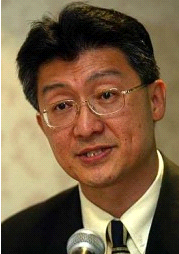
Chang Kim Loong
“(The requirement) comes along with a mandatory statutory format for the sale and purchase agreement under the Housing Development (Control and Licensing) Regulations 1989,” explained Chang, adding that the requirement and format are for the protection of house buyers and cannot be deviated from. “The relevant schedules are G, H, I and J.”
With the standardised sales and purchase agreement (SPA), terms and conditions are also uniform. Additionally, developers registered with the Ministry of Housing and Local Government are vetted for licensing and all sales and advertisement permits.
“It shows how stringent the law is to make sure no buyers are cheated,” said Chang of HBA. “In addition, the housing tribunal has existed for about ten years, delivering justice to aggrieved house buyers — the housing law is there to protect them.”
“So when PR1MA was started, why are they not conforming to these laws?” asked Chang. “Why is there no standardised SPA?”
In response to KiniBiz queries, PR1MA reiterated its main objective of addressing the housing needs of the urban middle-income group by providing affordable, quality houses and integrated communities.
However, PR1MA added that certain measures of control has to be put in place which include a moratorium period and specific terms and conditions over and above the provisions of the standard SPA as currently provided under the Housing Development Act. In addition, unlike commercial housing developers PR1MA faces a much bigger task — providing 500,000 units of affordable houses to be sold below market price.
“To enable PR1MA to meet this objective and target, it is inevitable and also more expedient for PR1MA to be exempted from the provision of the Housing Development Act and be empowered with specific powers under the PR1MA Act,” said PR1MA Corporation chief executive officer (CEO) Abdul Mutalib Alias. “Notwithstanding such exemption, PR1MA as a statutory body is governed by the provisions of the PR1MA Act and is answerable to the Minister in charge of PR1MA who is none other than the Prime Minister himself.”
No access to housebuyer tribunal?
A law academic who declined to be named noted that setting up PR1MA under a different legislation is a concern, as it is unclear so far whether the Housing Development (Control and Licensing) Act would apply to developments carried out under PR1MA.
“It is a very serious matter as that means we are not sure if even the feeble protection given by the Act is available to PR1MA house purchasers,” said the law academic. “The housing tribunal which is available to purchasers under the Housing Development Act, will it also be available to PR1MA purchasers?”

Azlinor Sufian
It is worth noting that in a 2012 academic paper titled “Housing Development and PR1MA: Myth or reality?”, Dr Azlinor Sufian from International Islamic University Malaysia (IIUM) observed that section 56 of the PR1MA Act established an Appeal Tribunal for anyone aggrieved by the decision or direction of the PR1MA corporation to lodge an appeal. However, Azlinor felt it is absurd to establish an Appeal Tribunal instead of a proper Tribunal.
“For protections of interest of all persons that are governed by PR1MA, it is very significant to have a Tribunal because there can be a situation where those persons may want to claim for breach of contract against the Corporation,” wrote Azlinor. “But since it is an Appeal Tribunal, such a claim cannot be initiated before it.”
In response, PR1MA CEO Abdul Mutalib Alias acknowledged that due to the restriction under the current provisions of the Housing Development Act, PR1MA homebuyers would not have access to the Tribunal for Homebuyer Claims if PR1MA is exempted from the Housing Development Act’s provisions.
“However, they are still protected by other provisions of the law in an unlikely event of a breach by PR1MA of its obligations under the SPA,” said Abdul Mutalib. “PR1MA will also continue to work closely with the Ministry of Urban Wellbeing, Housing and Local Government with regards to matters relating to PR1MA house buyers so that their rights as a house buyer will continue to be protected.”
‘Developers add a layer of cost’
 While many question marks remain on the PR1MA Act itself, another aspect of PR1MA implementation that is in the crosshairs is the involvement of private developers in some PR1MA developments.
Arguing that PR1MA is meant to build affordable housing by unlocking government landbank, Chang of HBA questions why PR1MA needs to enter into joint ventures (JV) with private developers in the first place.
To clarify his point, Chang said that developers are in the business to make money and raises the question of why, as guardian as the government’s land, PR1MA needs to give these land to developers and share the profit when PR1MA could be a developer in its own right.
“Shouldn’t PR1MA operate the same way as (Singapore’s) Housing Development Board (HDB), with the same kind of concept whereby they become developers themselves?” asked the HBA honorary secretary-general. “Why share profit with developers?”
“Entering into JV with profit-seeking entities defeats the purpose of PR1MA,” argued Chang.
In agreement with Chang, the law academic who declined to be named argued that bringing in developers into PR1MA developments mean that the prices of PR1MA houses would not be as low as they can be since developers will be looking for profits too.
This is not acceptable because the cost of the houses are already hugely subsidised by the government, since the land for PR1MA housing is the government’s own landbank which would be made available for free, said the academic.
“If this land is given free to developers, they are going to make some profit out of it — why should that be (allowed)?” asked the academic.
‘But developers bring efficient delivery’
However, developers do bring value to the table, said NK Tong, group managing director of Bukit Kiara Properties, when posed the question by KiniBiz recently, adding that the private sector’s efficiency may be the reason why PR1MA engages private developers.

NK Tong
“I don’t know about Malaysia, but governments worldwide are not necessarily the most efficient and effective in delivering certain things,” said Tong, who is also the national treasurer of the Real Estate and Housing Developers Association (Rehda). “So I think what (PR1MA) wants to do is get competition to come in and compete to deliver these homes faster for them.”
“Either (they do) that or they have to hire a whole new cost construction department — quantity surveyors, architects, builders, etc…can the government do that efficiently?” Tong added.
Mani Usilappan, principal of Mani Usilappan Chartered Surveyors, feels that the issue is basically about government getting into business. “I don’t think the government is an entrepreneur, it is in more cases a regulator and also policymaker who sets the direction (of things).”
“When you get involved into the implementation of projects, you take the role of entrepreneur,” added Mani. “So government servants would not want to be risk-takers, they want to ensure everything is provided for.”
As such the government’s role is often different from entrepreneurs such as developers, who takes risk upon seeing opportunities and implement their action plan to capitalise on the opportunities. Government bureaucracy means the operating procedures are greatly different from how entrepreneurs work to accomplish their goals.
“Involving themselves directly in business (activities) means taking business risk, but I do not think government servants can take business risks,” said Mani. “Government servants cannot say they lose (the government’s) money and live with it.”
Therefore government servants perform their duties according to prescribed standards of practices, said the surveyor. “Risk-taking as entrepreneurs is not part of the training or mindset of a government servant.”
“Government should remain regulators, enablers and effective enforces but never implementers,” added Mani.
‘Government land is limited’
When KiniBiz posed the issue to PR1MA, the corporation explained that contrary to public perception, government land allocated for PR1MA to date is actually very limited and insufficient even for the 80,000 homes targeted for 2013, let alone its mandate of 500,000 PR1MA homes by 2018.
Therefore to meet its goals within the timeframe it was given, PR1MA looks to public–private partnership projects to jumpstart the developments while identifying suitable land for its own development.
“While recognising the profit-oriented nature of private developers, PR1MA remains focused (that it can) achieve its affordable price (target) which is 20% below market (price) at the onset,” said PR1MA CEO Abdul Mutalib. “This involves thorough negotiations and understanding on the part of private developers towards PR1MA’s pricing objectives.”
In addition, PR1MA has iterated in the past that it has several different development models for its developments, one of which involves the corporation taking on the role of sole developer.
Wholesome development and BTS
On the other hand, some also question why PR1MA incorporates commercial elements into its developments when its mandate was to provide affordable housing.
 “It has come to our attention that some parts of (PR1MA’s land) are being put aside for commercial (developments) and high-end condominiums,” said HBA honorary secretary-general Chang. “Why are they not doing wholesome affordable housing?”
Since the land is government land, Chang argues that it must be used to provide affordable housing for PR1MA’s target group. “I came to understand that (only) 40–50% is used for affordable housing. What about the rest?”
The issue is why free government land is used to make money as the only cost involved would be the construction cost, said Chang, adding that it is not fair to the people.
However, the profit from these commercial elements are actually for the PR1MA homebuyers themselves, said the corporation in response to KiniBiz queries on the matter.
While PR1MA’s main objective is to provide affordable housing to the middle-income group, PR1MA will also provide maintenance for its buildings and facilities, said PR1MA CEO Abdul Mutalib.

Abdul Mutalib Alias
“As such, some commercial elements are included in some of (our) developments to ensure that there are revenue streams to subsidise these costs so they can be kept minimal for PR1MA housebuyers,” said Abdul Mutalib.
Abdul Mutalib is referring to PR1MA’s maintenance program which was previously mentioned by PR1MA chief operating officer Ar Aminuddin Abdul Manaf, whereby the program would comprise physical and social maintenance to ensure the value of PR1MA homes do not depreciate.
“We also maintain the social structure to ensure the community will live in harmony and in an environment that is sustainable,” Aminuddin was quoted as saying.
But as the government arm tasked with providing affordable housing, shouldn’t PR1MA also lead the way as far as the build-then-sell (BTS) concept goes?
Under the BTS concept which is set for implementation in 2015, developers would have to finance most of their development cost before completion. This contrasts with the current situation where each stage of the construction process is financed by buyers until completion.
“Why wait until 2015? I believe in leadership by example — PR1MA should start first and be the forerunner,” said Chang of HBA.
In response, PR1MA CEO Abdul Mutalib said that PR1MA is currently assessing all available options and their respective potential cost impact.
“Our focus remains on providing PR1MA homes that are financially affordable to promote greater home ownership among the country’s middle-income households,” said Abdul Mutalib, implying that the corporation’s attention is only on the directive it is tasked with and nothing else.
Yesterday: The widening housing affordability gap
Tomorrow: Can PR1MA fight the affordable housing battle alone?
You must be logged in to post a comment.