


By Khairul Khalid
 Malaysia’s rise as a regional power has also seen an equal rise in corporate misdeeds over the decades. In this first of a four-part series, we look at Malaysia’s growth in the 1980s, the decade which also spawned the first wave of mega scandals involving both corporate and public entities.
_____________________________________________________________________
Malaysia’s rise as a regional economic power over the last few decades saw it embark on infrastructure and manufacturing projects, starting in the 1980s, that were of unprecedented scale and complexity in the nation’s history. These huge undertakings dubbed “mega projects” cost billions and thrust the country into the global spotlight.
On the other end of the nation building spectrum, Malaysia has also been tainted by corporate misdeeds of an equally massive scale. Despite its negative effects on Malaysia’s reputation as a developing country, these “mega scandals” have persisted over the decades in various shapes and forms.
Are these scandals an inevitable price that the country pays for progress, or are they symptoms of a larger malaise in the Malaysian economic and political system?
Wave of scandals in 80s
 The 1980s saw the launch of an intensive industrialisation drive led by Prime Minister Dr Mahathir Mohamad and several ambitious projects such as the national car, Proton. Malaysia’s first Industrial Master Plan (IMP) was published in 1986.
Arguably, the decade also spawned the first wave of mega scandals involving both corporate and public entities.
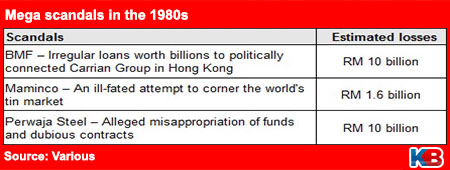
In 1983, a banking scandal shook not just Malaysia, but the entire world. The BMF (Bumiputra Malaysia Finance) fiasco was one of the world’s biggest bank collapse at the time and involved dubious loans amounting to RM2.5 billion from BMF to the Carrian Group, an ailing company in Hong Kong that was run by well-connected Malaysian businessman George Tan.
The case that gripped Malaysia involved not just corporate shenanigans, but also the murder of Jalil Ibrahim, an auditor who was sent to Hong Kong by BMF’s parent company BBMB (Bank Bumiputra Malaysia Bhd). One of the biggest banks in the region at the time, BBMB was set up to support the government’s Bumiputra policies.
Corruption and murder in the BMF scandal
Jalil went to Hong Kong to investigate irregularities found in BMF’s dealings with Carrian Group but was found strangled in a banana grove. A small time Sarawakian businessman Mak Fook Than was convicted of Jalil’s murder and sentenced to life in prison, but more than 30 years after the case lingering questions still remain. Who ordered the hit on Jalil and why?

Lorrain Esme Osman
The popular theory is that Jalil had discovered too much about BMF’s dealings with Carrian Group and was about to blow the whistle on everyone implicated, including top politicians and prominent figures at the time. BMF’s former chairman Lorrain Esme Osman fled to London to fight extradition to Hong Kong to face legal charges. He was eventually extradited and spent only few months in jail. Lorrain lived in London in exile until his death in 2011.
Two other BMF directors Hashim Shamsuddin and Rais Saniman were also jailed in Hong Kong. Despite an inquiry by a Royal Commission, no other Malaysian officials were ever charged in the case. The government had to bail out the floundering BBMB with a US$1 billion capital injection. Carrian Group subsequently filed for bankruptcy. BBMB was eventually absorbed into CIMB.
Exploiting political connections
The BMF scandal was one of the first mega scandals in Malaysia but it has definitely not been the last. Many other scandals of equal, if not bigger, scale have followed in the successive decades.
What have been the some of the main catalysts for these mega scandals?
“These scandals usually originated with supposedly ‘good’ intentions but are eventually co-opted by individuals with political connections who want to exploit these opportunities for commercial gain,” said Ong Kian Ming, member of parliament (MP) for Serdang.
Another scandal in the early 80s, ironically also linked indirectly to BBMB, was the Maminco-Makusawa scandal.
Maminco was a RM2 company used to drive up prices of tin at the London Metal Exchange. Maminco received funding from BBMB loans of RM1.5 billion. It bought tin future contracts and physical stocks of tin. The company got into serious financial trouble after tin prices collapsed. Subsequently, the Malaysian government set up another company Makuwasa to recoup the losses incurred by the Maminco debacle.
The Perwaja fiasco
Another prominent scandal in the 80s was Perwaja Steel, a name that is still synonymous with the government’s bailout of failed business ventures. An estimated RM10 billion was lost in the Perwaja Steel fiasco.
Perwaja Steel was a joint venture between Terengganu state, Nippon Steel Corporation and Perwaja Terengganu Sdn Bhd conceived to transform Malaysia into a powerhouse steel producer and help Malaysia on its path to industrialisation. It was launched in 1982 and the government’s Hicom had a 51% stake in Perwaja Steel.
It soon incurred massive losses and Nippon Steel pulled out of the project. In 1988, Hicom divested Perwaja Steel and Eric Chia (a close ally of Mahathir) was given the task to turn around the company. Chia was a founder of UMW Holdings Bhd, a company specialising in heavy equipment.

Eric Chia
Despite the change in management and billions pumped into the company by the government, Perwaja Steel still bled tons of money. Chia helmed Perwaja Steel for seven controversial years 1988-1995, during which there were allegations of misappropriation of funds, dubious contracts and dishonest accounting. He was charged for CBT (criminal breach of trust) in 2004 but was acquitted three years later.
Greed and temptation
Although the involvement of the government is seen as a necessity in big deals such as major infrastructure projects that require exorbitant capital and resources, it can also have its downsides at the expense of public funds, as the mega scandals have shown.
“With implicit or explicit government backing, big risks are taken without due consideration for the possible downsides which normal commercial companies have to consider. Private gain, public risk,” said Ong.
According to Yeah Kim Leng, Dean of School of Business at Malaysia University of Science and Technology (Must) other key contributors to these scandals are poor governance, inadequate risk management and lack of protection for whistleblowers who want to expose corruption.

Yeah Kim Leng
Yeah says that although establishing causality is more difficult as the scandals have varied contributory factors, we cannot reject the hypothesis that the inability to disentangle politics and business have played a catalytic role in the mega scandals.
“The higher the stake and the so-called ‘investment’ by businesses in funding certain parties or candidates, the larger the ‘pay-back’ expected, hence leading to pervasive corruption, inevitably leading to a few that take on a mega proportion.
“At the individual level, perpetrators see a much higher payoff than the penalty of being caught, if ever. They therefore take the easy way out when confronted with business challenges or overcome by greed and temptation,” said Yeah.
Tomorrow: Mega scandals of the 1990s
You must be logged in to post a comment.